
Every month, FinTech Innovations talks to GovCon founders who are staring at a profitable income statement and still can’t sleep because payroll is due Friday.
Here’s the thing nobody tells you when you start a contracting business: profitability and solvency are two different questions, and only one of them can bankrupt you on short notice.
The Scenario
FinTech Innovations built out a full financial model for a real mid-size GovCon client to show exactly where this disconnect shows up in the numbers. (Note: “Meridian Strategic Systems” is a placeholder name we use to protect the identity of the actual business — the figures and dynamics below are real.) Here’s the P&L for the year:
- Revenue: $10.17M
- Direct Costs: $8.70M
- Indirect Costs: $1.48M
- Net Income: approximately breakeven — call it flat
If you only looked at that number, you’d say Meridian is a stable, unremarkable business. Nothing to worry about.
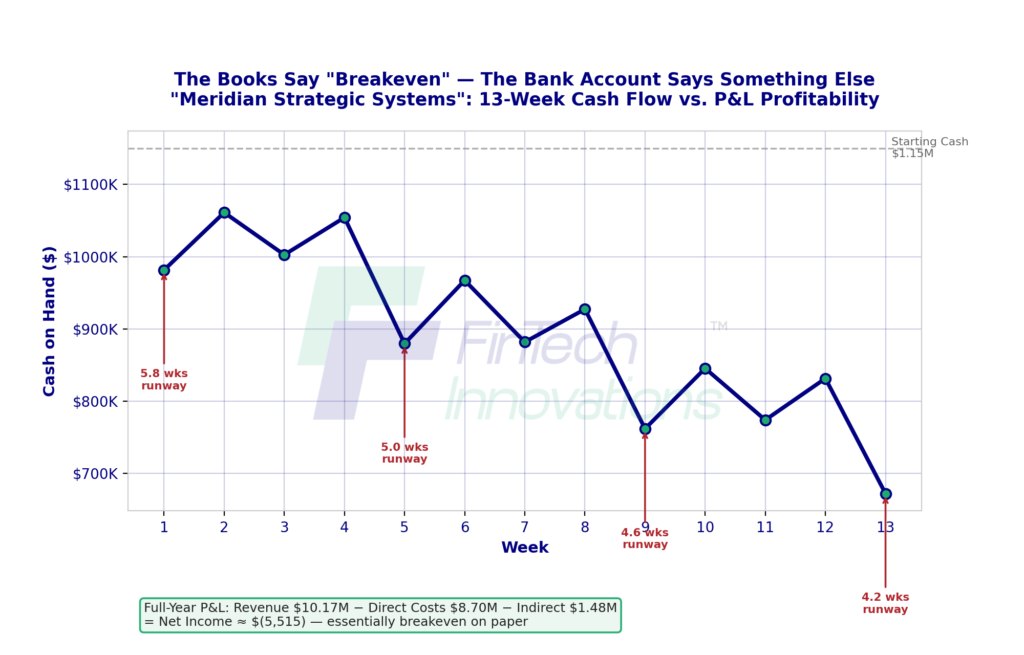
Now look at the same company’s actual cash position, week by week, over a 13-week window:
[SEE CHART: Cash Flow vs. Profitability]
That’s the same “breakeven” business swinging from $1.15M down to $672K and back up multiple times — with cash runway dropping to as low as 4.2 weeks during payroll-heavy stretches. Four separate times in one quarter, this company was less than a month away from a cash crunch, and the P&L never once said a word about it.
Why This Happens in GovCon Specifically
This isn’t a math error. It’s structural, and it’s almost universal in government contracting:
- Payroll runs biweekly. Collections run on government time. You’re paying your team every two weeks regardless of whether the agency has paid you. A 30-, 60-, or 90-day invoice cycle doesn’t care about your payroll calendar.
- Net income is an accrual concept. Your bank account is not. Revenue gets recognized when it’s earned, not when the check clears. Direct labor gets expensed when it’s incurred, not necessarily when cash physically leaves.
- Indirect costs don’t pause for a slow collections month. Overhead, G&A, and fringe keep accruing on a steady drumbeat while collections arrive in lumps.
The result: a company can be profitable on paper and thirty days from missing payroll at the same time. FinTech Innovations has seen it happen. It’s one of the fastest ways a good business ends up in a bad spot — not because the work wasn’t profitable, but because nobody was watching the gap between “earned” and “collected.”
What We Actually Do About It
This is the exact reason the “Meridian” model — and every engagement model FinTech Innovations builds for clients — includes a 13-week rolling cash forecast as a standing deliverable, not a one-time exercise.
Concretely, here’s what that means for a client:
- Weekly visibility, not monthly hindsight. By the time a monthly P&L tells you there’s a problem, you’ve already missed the window to fix it.
- Runway flagged in weeks, not dollars. A dollar figure doesn’t mean anything without context. “4.2 weeks of runway” tells a founder exactly how much time they have to act.
- Collections and payroll mapped on the same timeline, so you can see the collision coming before it happens instead of after.
- A decision tool, not just a report. When we show a client their runway dropping to four weeks in week 9, the conversation isn’t “here’s a number.” It’s “here’s what we do about it” — accelerate an invoice, delay a non-critical vendor payment, draw a line of credit, or renegotiate payment terms on a specific contract.
Profitability tells you if the business model works. Cash flow tells you if you survive long enough to prove it. GovCon founders need both, and most are only getting one.
If you’re running a contracting business and you’ve never built a rolling cash forecast, that’s the single highest-leverage thing you can add this quarter. FinTech Innovations is happy to walk through what that looks like for your specific contract mix — reply to this email or grab time on our calendar.
— FinTech Innovations LLC Fractional CFO & Strategic Finance Partner for Growing GovCon Businesses
