
Let me ask you something straight.
If someone called you right now and asked which of your contracts is most profitable after you back out all your direct labor, overhead, and other direct costs, could you answer in 30 seconds?
If someone asked what your real cash runway is if your largest federal payment slips 45 days, could you tell them without pulling up a spreadsheet and spending two hours on it?
If a DCAA auditor knocked on your door tomorrow, would your timekeeping system, indirect cost pools, and billing documentation hold up?
If the answer to any of those is no, this newsletter is for you.
Not because something is wrong with you or your business. Because the financial role that answers those questions has probably never existed in your organization. And until you understand which role fills which gap, you will keep making high-stakes decisions with incomplete financial visibility.
That is the gap FinTech Innovations was built to close.
First, Understand That These Are Three Completely Different Jobs
Most business owners lump bookkeeping, accounting, and financial leadership together as if they are the same thing with different price tags. They are not. They solve fundamentally different problems. Confusing them is one of the most expensive mistakes a growing business makes.
Here is the breakdown.
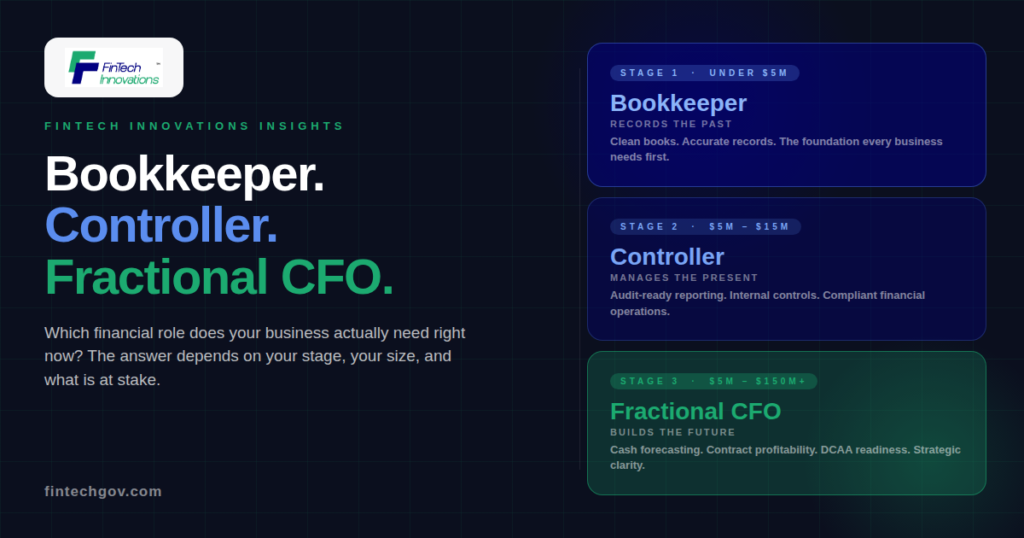
A bookkeeper records what already happened.
They track every transaction. They categorize income and expenses. They reconcile your bank accounts. They keep your books clean and current. This is essential, foundational work. But a bookkeeper looks backward. They tell you what you spent and what came in. They do not tell you what it means, what is coming, or what to do about it.
A controller manages and verifies your financial operations.
A controller sits above the bookkeeper and owns the integrity of your financial system. They manage the monthly close, enforce internal controls, make sure your reporting is accurate and on time, and keep you audit-compliant. If a bookkeeper records the data, a controller makes sure it is right, trustworthy, and structured correctly. A controller still operates mostly in the present and the recent past. They make sure your financial house is in order.
A fractional CFO looks forward and turns your numbers into strategy.
A fractional CFO takes the clean, accurate data your bookkeeper and controller produce and uses it to answer the questions that actually keep business owners up at night. Which contracts or products make money and which ones quietly drain it? What is the real cash runway if conditions shift? Can you afford to hire? Should you bid that next contract? What does a 20% revenue drop do to your business? A fractional CFO is the financial brain of the business. Not a reporter of numbers. A user of numbers.
Past. Present. Future. Three completely different jobs.
Which One Does Your Business Need Right Now?
The answer depends on your stage, your size, and your specific pain. Here is the honest breakdown by revenue range.
Under $1M Revenue: Start With Bookkeeping
At this stage, your primary need is clean books. If your transactions are not being recorded accurately and consistently, nothing else can work. You cannot analyze what you cannot measure.
What you need: A reliable bookkeeper or a bookkeeping service, either a person or software like QuickBooks Online or Xero with monthly oversight. Expect to spend $300 to $1,500 per month.
What you do not need yet: A fractional CFO. Not because your finances do not matter, but because the strategic financial questions at this stage are relatively straightforward and your revenue base does not justify the spend. Focus on getting clean, consistent records first.
$1M to $5M Revenue: Clean Books Plus Basic Strategic Oversight
At this stage you need accurate bookkeeping plus someone who can help you understand what the numbers mean. Cash flow is becoming more complex. Decisions about hiring, pricing, and growth require more than a bank balance check.
What you need: A strong bookkeeper plus periodic fractional CFO support. Monthly or quarterly engagements to review profitability, build a cash forecast, and stress-test your business model before major decisions.
The cost of not having it: Business owners at this stage make the most expensive decisions on gut feel. Hiring before they can afford it. Pricing below margin because they do not know their fully loaded costs. Running out of cash while posting solid revenue. This is where financial clarity has the highest return on investment.
$5M to $15M Revenue: The Danger Zone
This is the stage where the complexity of your business has outgrown the simplicity of your financial infrastructure. You probably have multiple revenue streams, multiple employees, and multiple moving parts. But you likely still do not have a full-time financial leader.
For government contractors specifically, this is also the stage where DCAA compliance, indirect rate management, and contract-level profitability analysis stop being optional. A single underperforming contract can quietly drain the cash that your healthy contracts generate. Most owners at this stage cannot tell you which one it is.
What you need: A fractional CFO on a monthly retainer. Not a quarterly check-in. Monthly financial leadership that includes a 13-week cash flow forecast, contract or product-level profitability analysis, and a clear read on your indirect rate structure. You still need your bookkeeper. You add the strategic brain on top.
For GovCon firms: If you are doing T&M, FFP, or CPFF work at this revenue level without someone actively managing your indirect rates, billing compliance, and contract profitability, you are flying blind in a regulated environment. That is expensive.
$15M to $50M Revenue: Fractional CFO Plus Controller
At this revenue level, your transaction volume and financial complexity require both. A controller to run the accounting operation cleanly and on time, and a fractional CFO to translate the clean data into strategic decisions.
You cannot have a CFO without trustworthy data. You cannot have trustworthy data without a controller keeping the operation disciplined. These are complementary roles, not competing ones.
For government contractors at this level: You likely have multiple prime contracts, multiple agency relationships, a proposal pipeline, and a DCAA audit history or an upcoming audit. Your indirect rate structure directly affects your competitiveness on bids. Your contract profitability directly determines whether your growth is sustainable. These are CFO-level functions that cannot be delegated to a bookkeeper.
What this tier costs full time: A Controller runs $70,000 to $120,000 per year. A CFO runs $200,000 to $400,000 per year. Combined, you are looking at $270,000 to $520,000 before benefits and bonuses.
What a fractional alternative cost: $3,000 to $8,000 per month for combined fractional CFO and controller support. You get the expertise without the overhead.
$50M to $150M Revenue: The Enterprise GovCon Profile
At this scale you need a full-time controller and likely a full-time CFO. But even here, there is a role for fractional CFO support during specific transitions: a major contract recompete, a teaming arrangement with a large prime, a DCAA audit, or a capital raise.
For firms in this range, the financial operating system has to be institutional. Cash forecasting is not a monthly exercise. It is a weekly discipline. Contract profitability is not an annual review. It is a live dashboard. Indirect rate management is not a year-end surprise. It is a continuous operational metric.
The Question Most Business Owners Never Ask
Here is the thing about financial leadership that no one talks about:
The absence of a fractional CFO is not neutral. It is expensive.
Every month that passes without a rolling cash forecast is a month where you cannot see the coming pressure. Every contract bid that goes out without someone validating the indirect rates and labor pricing is a margin risk that compounds over the life of the contract. Every hiring decision made without a clear view of cash runway is a potential cash flow crisis in the making.
The cost is not always visible as a line item. It shows up as the contract you did not realize was losing money. The employee you hired three months too early. The payment slip that turned into a cash crisis because nobody was watching the 13-week horizon.
That is the gap a fractional CFO closes. And for most growing businesses, especially government contractors in the $5M to $100M range, a fractional CFO delivers more strategic value per dollar than almost any other financial hire.
What FinTech Innovations Delivers
FinTech Innovations provides fractional CFO and strategic FP&A leadership for growing businesses and government contractors. I built the GovCon CFO Operating System, a complete financial command center that includes:
Contract-level and product-level profitability analysis. You see exactly which parts of your business make money and which ones bleed it. No more guessing.
13-week rolling cash flow forecast. You see what is coming before it arrives. You stop being surprised and start being proactive.
Indirect rate tracking and optimization. For government contractors, your indirect rates directly affect your competitiveness and your compliance. We keep them calibrated, documented, and defensible.
Power BI financial dashboards. Nine dashboards that give leadership a live read on every key financial metric without pulling a report.
DCAA audit readiness. A scored readiness assessment that tells you exactly where you stand and what to fix before the auditors ask.
Board-grade financial reporting. Clear, executive-ready reporting that turns complex numbers into confident decisions.
This is CFO-level financial leadership without the $250,000 salary. For businesses that have outgrown their bookkeeper but are not yet ready for a full-time executive, this is the system.
The Bottom Line
A bookkeeper records the past.
A controller manages the present.
A fractional CFO builds the future.
Most growing businesses have the first. Some have the second. Almost none have the third. And that is exactly why so many profitable companies still run out of cash, overpay on contracts they should not have bid, and make their most consequential decisions on gut feel instead of numbers.
You have worked too hard building your business to let financial blind spots be the thing that slows you down or takes you out.
Ready to See What Financial Clarity Looks Like for Your Business?
FinTech Innovations is currently onboarding a limited number of new clients for the GovCon CFO Operating System. Whether you are a growing small business or a government contractor managing multiple federal contracts, the first conversation is free.
Book your free 30-minute Financial Clarity Call at fintechgov.com
In 30 minutes, you will get a straight read on where your finances stand, what the biggest gap is, and what it would take to close it. No pitch. No pressure. Just a clear assessment from a finance leader who has spent 10+ years inside DoD, the intelligence community, and the private sector building the exact systems your business needs.
Visit fintechgov.com to book your call or download the free GovCon Cash-Flow Survival Checklist.
© FinTech Innovations LLC | fintechgov.com
